
Are You Ready to Spar? How West End Athletic Club Decides When a Beginner Moves From Bag Work to the Ring
Last updated: September 27, 2026
Published September 27, 2026 · Updated September 27, 2026
When is a beginner ready to spar in boxing in Etobicoke: at West End Athletic Club, 283 Bering Ave, you are ready when a coach has watched you keep your guard, move your feet and throw controlled punches consistently in technique classes. The decision rests on what the coach sees, not on a date on the calendar. Sparring here is optional and always coach-supervised, so a complete beginner's next step is technique classes (the 3 Classes for $30 intro is the simplest way in), followed by a conversation with a coach about Beginner Sparring.
- Sparring at West End Athletic Club is optional and coach-supervised, so no member at 283 Bering Ave has to spar in order to train.
- Sparring readiness is judged by a coach watching your guard, footwork, controlled punching and calm defensive reactions, including near the end of a 50-minute class when you are tired.
- Beginner Sparring and Advanced Sparring are two separate classes on the West End schedule, and new sparrers start in Beginner Sparring.
- A coach's not yet is a to-do list rather than a verdict: you keep training in technique classes and ask to be reassessed.
- Complete beginners in Etobicoke can start with the 3 Classes for $30 intro, or call 416-621-1234 to ask about the 2-week intro offer.
- West End's coaching team includes a 3-time Canadian Heavyweight Champion and a Team Canada boxer.
Most people assume the sparring question is about toughness. It almost never is. What a coach actually watches is quieter: what your hands do when you are tired, and whether your eyes stay open when a glove comes toward your face.
The question tends to surface a few months in. You can wrap your hands without looking, the dull thud of the bag floor has faded into background noise, and one evening you catch yourself watching the ring instead of your own combination. That is the moment this article is written for.
If you are a beginner from Mimico, Islington or The Kingsway who has been coming to technique classes and keeps wondering whether you are even allowed to ask about sparring, the short answer is yes. This is written for the person who has never been hit and is not sure they want to be, not for an experienced fighter looking for hard rounds.
- The specific signs a West End coach looks for before a member spars for the first time
- The six skills you should own from technique classes before any live rounds
- How Beginner Sparring differs from Advanced Sparring on the club schedule
- The exact questions worth asking a coach before you step through the ropes
- What happens, step by step, if a coach tells you that you are not ready yet
- When is a beginner ready to spar in boxing at an Etobicoke gym?
- What should a beginner be able to do before sparring?
- The Process, Step by Step
- What gear and tools are involved in beginner sparring?
- How is Beginner Sparring different from Advanced Sparring?
- Where It Gets Tricky
- What happens if a coach says you're not ready yet?
- What This Means for You as the Customer
- Our take after more than a decade of coaching
- Frequently Asked Questions
- Sources
When is a beginner ready to spar in boxing at an Etobicoke gym?
A beginner at West End Athletic Club in Etobicoke is ready to spar when a coach sees four things show up consistently. The first is a guard that returns to your face after every punch. The second is footwork that keeps you balanced, the third is punching with control instead of maximum force, and the fourth is defensive reactions that keep your eyes open.
None of those require you to be especially fit, strong or aggressive. They require repetition. That is good news for a complete beginner, because repetition is something anyone can show up for.
Consistently is the word doing the heavy lifting. One sharp night on the pads does not settle it. The coach is looking for the same habits across many classes, including the final rounds of a 50-minute session when your shoulders burn and your breathing gets loud.
The decision is shared. A coach decides whether you are technically ready, and you decide whether you want to spar at all, because sparring at West End is optional. Plenty of people box for fitness, stress relief or pure skill and never take a sparring round, and that is a complete way to train.
The coaching team includes a 3-time Canadian Heavyweight Champion and a Team Canada boxer. That background matters here less for the titles than for the eye. People who have spent years in the ring notice a dropped hand or a flinch long before a beginner notices it in themselves.
What should a beginner be able to do before sparring?
A West End beginner should be able to do six things from the technique classes without thinking hard about them before a first sparring round. Think of them as the floor you stand on once someone starts moving in front of you.
- Stance and guard: feet roughly shoulder-width apart, weight balanced, hands up by the cheekbones, chin tucked, elbows in. You should drift back into it on your own after every exchange.
- Straight punches that come home: a jab and a cross that return to guard as fast as they went out. The return matters more than the snap.
- Combinations on call: throwing the combination a coach calls, at the pace the coach asks for, rather than your own favourite rhythm.
- Footwork that doesn't cross: stepping, retreating, pivoting and circling without crossing your feet or squaring up.
- Basic defence: blocking, parrying, slipping and rolling at partner-drill speed, with your eyes on your partner the whole time.
- Breathing and pacing: exhaling on your punches and not burning out in the first round of work.
Nothing on that list is exotic. It is the core of what technique work builds, which is exactly why the coach watches for it there first. A crossed foot on the bag floor is a small thing. In the ring, it is how you end up off balance.
If you have not taken your very first class yet, our earlier blog post, Your First Boxing Class in Etobicoke: What Actually Happens in the First 50 Minutes, covers that stage. This article picks up much later, once the basics feel familiar.
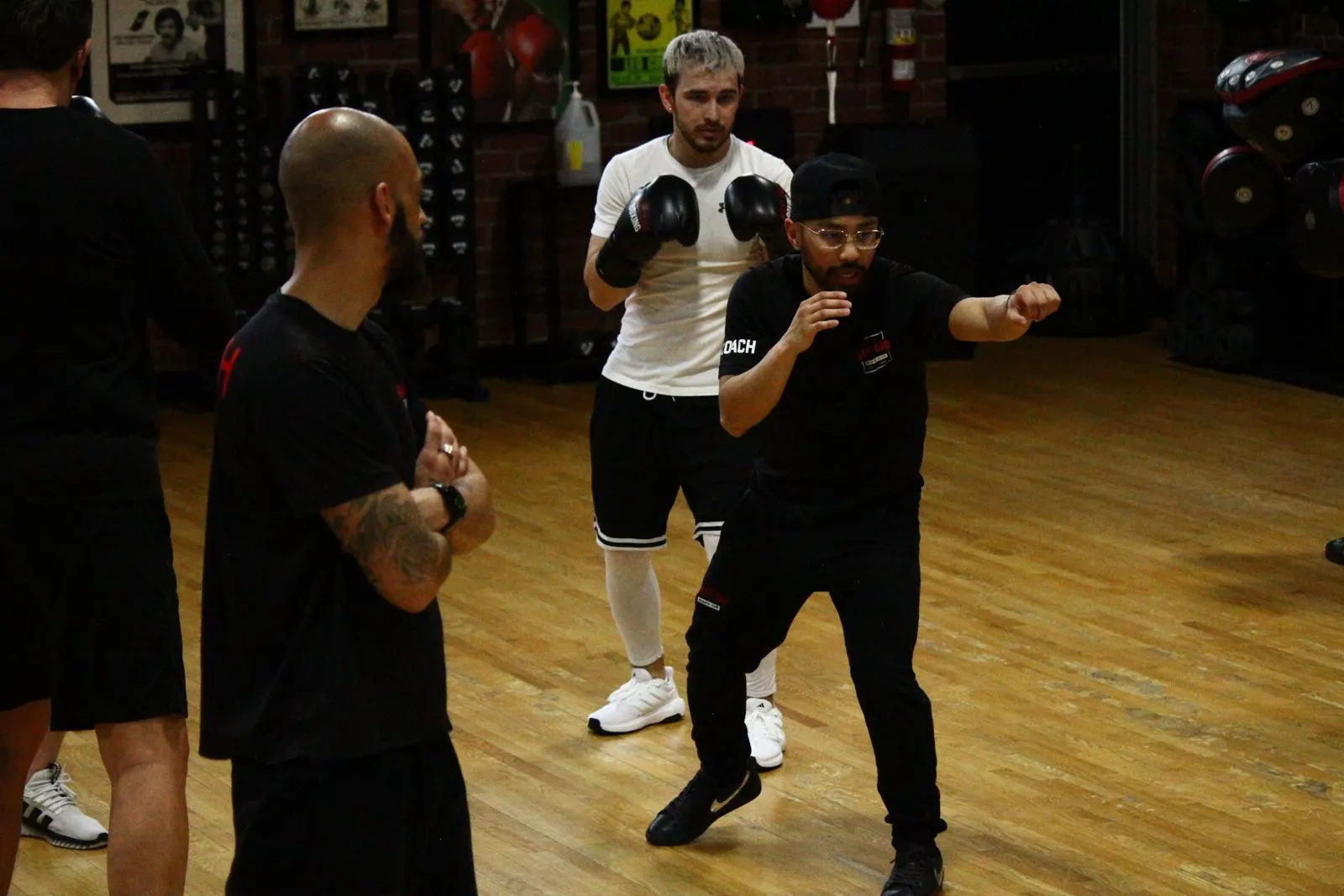
Actual photo: The Boxing Blueprint class at West End Athletic Club, 283 Bering Ave.
The Process, Step by Step: How does a coach decide a beginner is ready to spar?
The sparring readiness process at West End Athletic Club runs from the bag floor to the ring, and it is the honest answer to when a beginner is ready to spar at a boxing gym in Etobicoke. It is a sequence of things a coach watches for, not a test you pass once and forget.
- Build the base in technique classes. Every sparring path at West End starts in technique classes, where stance, guard, straight punches and footwork get drilled until they are automatic. Standard 180-inch hand wraps (Everlast and Title Boxing both sell them) are the usual starting kit, and learning to wrap properly is part of the base.
- Keep the habits when you're tired. Coaches pay close attention to the back half of a 50-minute class, when fatigue exposes everything. A guard that holds through the last round of pad work tells a coach more than a perfect first combination.
- Show control with a partner. Partner drills and pad rounds test whether you can throw at the pace someone else sets, touch rather than blast, and stop the instant you are told. Power is easy to add later. Control is what a coach needs to see first.
- Keep your eyes open under pressure. Flinching is normal for new boxers: blinking, turning the head, or throwing the hands up blind when a glove comes in. Controlled defensive drills gradually train that reflex out, and a coach wants to see calm eyes before any live rounds.
- Have the conversation. Sometimes a member asks, and sometimes a coach raises it. Either way, it is a two-way talk about why you want to spar (curiosity, confidence, fitness or an eye on competition) and whether the coach thinks you are there, with no pressure to say yes.
- Sort the gear. Sparring means dedicated protective kit: 16 oz gloves are the common sparring weight for most adults, alongside a fitted mouthguard, headgear and a groin protector. A coach will confirm what is required before your first round, so ask before you buy anything.
- Start in Beginner Sparring, coach-supervised. Your first live rounds happen in Beginner Sparring, one of two sparring classes on the West End schedule, with a coach watching and able to stop the action at any moment. The emphasis is control and learning, not winning rounds.
- Review, repeat, reassess. Coach feedback after sparring often sends you back to technique classes with one or two specific things to fix. Moving up to Advanced Sparring, or toward the Amateur Fight Team if you want to compete, is a later and separate conversation.
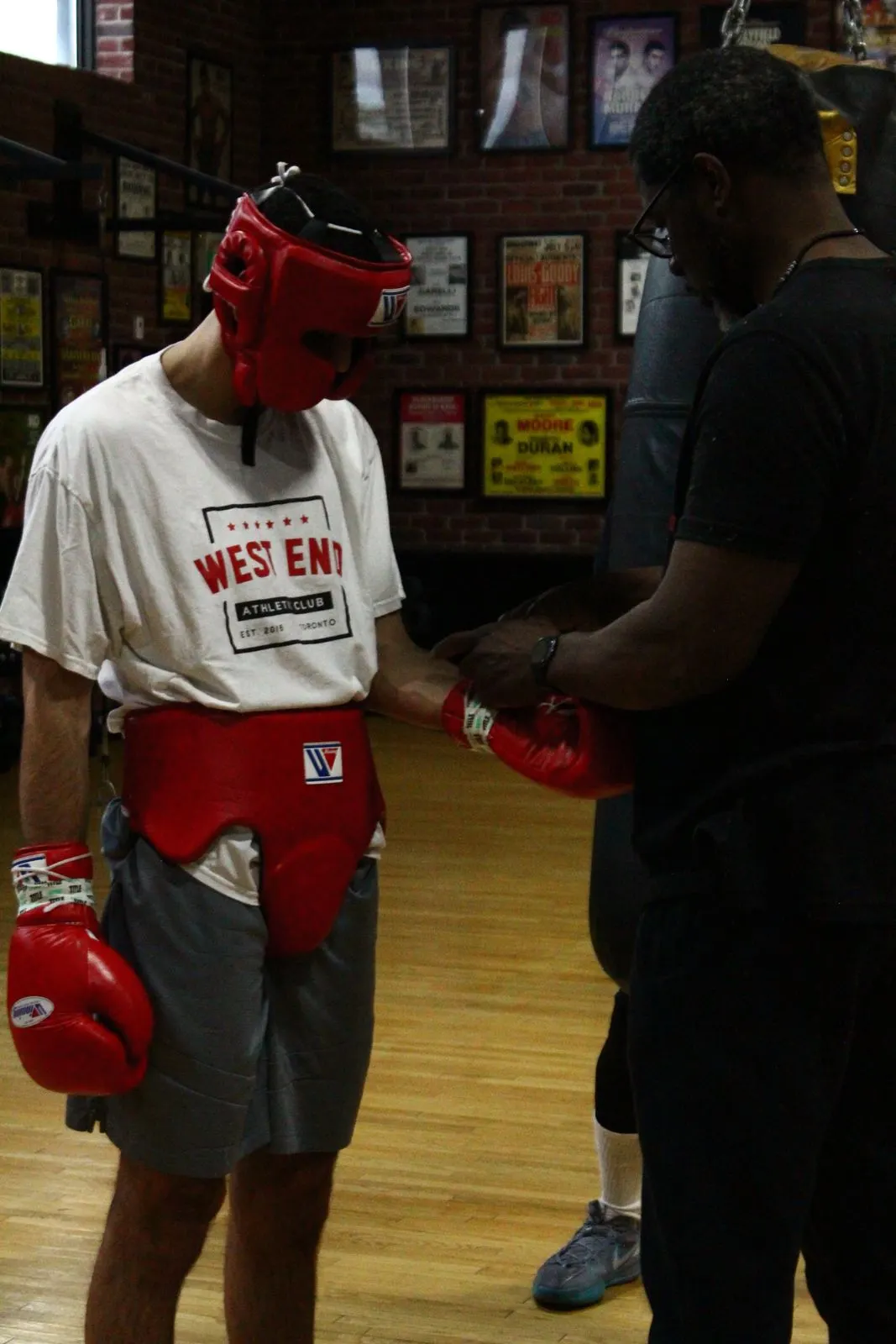
Actual photo: Beginner Sparring in the full ring at West End Athletic Club.
What gear and tools are involved in beginner sparring?
Beginner sparring at West End Athletic Club involves a short list of protective gear and training tools, and each one connects to something a coach is checking. The brands below are common, widely sold examples in boxing, not club requirements or endorsements.
| Tool or gear | Common examples | Why it matters for sparring readiness |
|---|---|---|
| 180-inch hand wraps | Everlast, Title Boxing | Support the wrist and knuckles; wrapping well is an early technique-class skill |
| 16 oz sparring gloves | Winning, Cleto Reyes, Hayabusa | Extra padding protects both partners; the common adult sparring weight |
| Mouthguard | Shock Doctor, SISU | Protects teeth and jaw; must fit properly before any live contact |
| Headgear | Title Boxing, Rival | Common protection in amateur-style sparring; ask the coach what is required |
| Focus mitts and a round timer | Title Boxing mitts, Gymboss interval timer | Pad rounds test control; timed rounds mirror the stop-start rhythm of sparring |
| The ring | West End's full ring at 283 Bering Ave | Where supervised sparring happens and ring awareness gets built |
One practical note: bag gloves and sparring gloves are not interchangeable in most gyms. Ask a coach before you buy, because the pair that feels great on a heavy bag is often lighter and firmer than what you want to be hit with.
How is Beginner Sparring different from Advanced Sparring at West End?
Beginner Sparring and Advanced Sparring are two separate classes on the West End Athletic Club schedule, and the difference is who they are for. Beginner Sparring is the supervised entry point for members new to live rounds. Advanced Sparring is for members who have already shown they can spar with control.
| Question | Beginner Sparring | Advanced Sparring |
|---|---|---|
| Who it's for | Members new to live rounds with a solid technique base | Members with consistent Beginner Sparring experience |
| Contact and pace | Light and controlled; the aim is touch, not damage | Faster and more demanding, still controlled |
| Coach's role | Close supervision with frequent pauses for coaching | Supervision with more room to work through rounds |
| What you work on | Guard, eyes-open defence, composure, controlled punching | Strategy, combinations under pressure, ring craft |
| How you get there | A coach sees consistent technique and you choose to try | A coach sees you stay safe and composed across many rounds |
The table shows how the two classes are positioned relative to each other. The exact drills on any given evening are set by the coach running the class, and current days and times are on the sparring class page.
Advanced Sparring is not a promotion you earn by showing up a certain number of times. It follows the same logic as the first step: a coach watches, and when the control is there, the conversation happens. Some members stay in Beginner Sparring happily for a long time. That is fine.
Where It Gets Tricky: Why do some beginners get held back from sparring?
Beginner sparring readiness goes sideways in a few predictable ways, and almost none of them are about fitness. The most common is intensity mistaken for readiness. The member who hammers the heavy bag hardest is sometimes the one whose right hand drops after every jab, and in live rounds that habit gets found out immediately.
The second is the quiet freeze. The first time a controlled punch lands, some beginners stop moving, stop punching and cover up. It is not a character flaw. It is a normal human reaction, and more controlled defensive work in technique classes is exactly what softens it.
The third is technique that only exists on the bag. A heavy bag hangs still on its chain and never hits back. Beautiful combinations can fall apart the moment someone steps sideways, which is why partner drills and pad rounds carry so much weight in the decision.
Gaps matter too. After a long break (a busy stretch at work, a summer away), habits fade faster than people expect, and a coach may suggest some technique classes before any rounds. Pairing is the last tricky part: a coach thinks about size, experience and temperament before putting two people in the ring together.
Honestly, the member who nervously asks whether they are ready is often further along than the one who insists they are. Nerves usually come with respect for what sparring is. That respect is half the battle.
What happens if a coach says you're not ready to spar yet?
When a coach at West End Athletic Club says you are not ready to spar yet, it means there are specific habits to fix, and you keep training in technique classes until they are fixed. It is not a door closing. It is a map.
Ask the coach which habit is holding you back: a dropped hand, crossed feet, a flinch or pacing. One named habit beats a vague feeling.
Put that one habit at the centre of every 50-minute class, on the bag and on the pads, until it holds when you are tired.
Ask for partner drills that pressure that exact habit, so the fix works against a moving person and not only a hanging bag.
If your technique fades as you tire, strength and conditioning classes such as Build & Burn on the West End timetable help your form last longer.
Once the habit feels automatic, ask the coach to take another look. Coaches notice effort, and asking shows you took the feedback seriously.
A not yet is common, and it is temporary. It is not a mark against you, and it says nothing about your toughness. It simply means the coach would rather your first rounds build confidence than dent it.
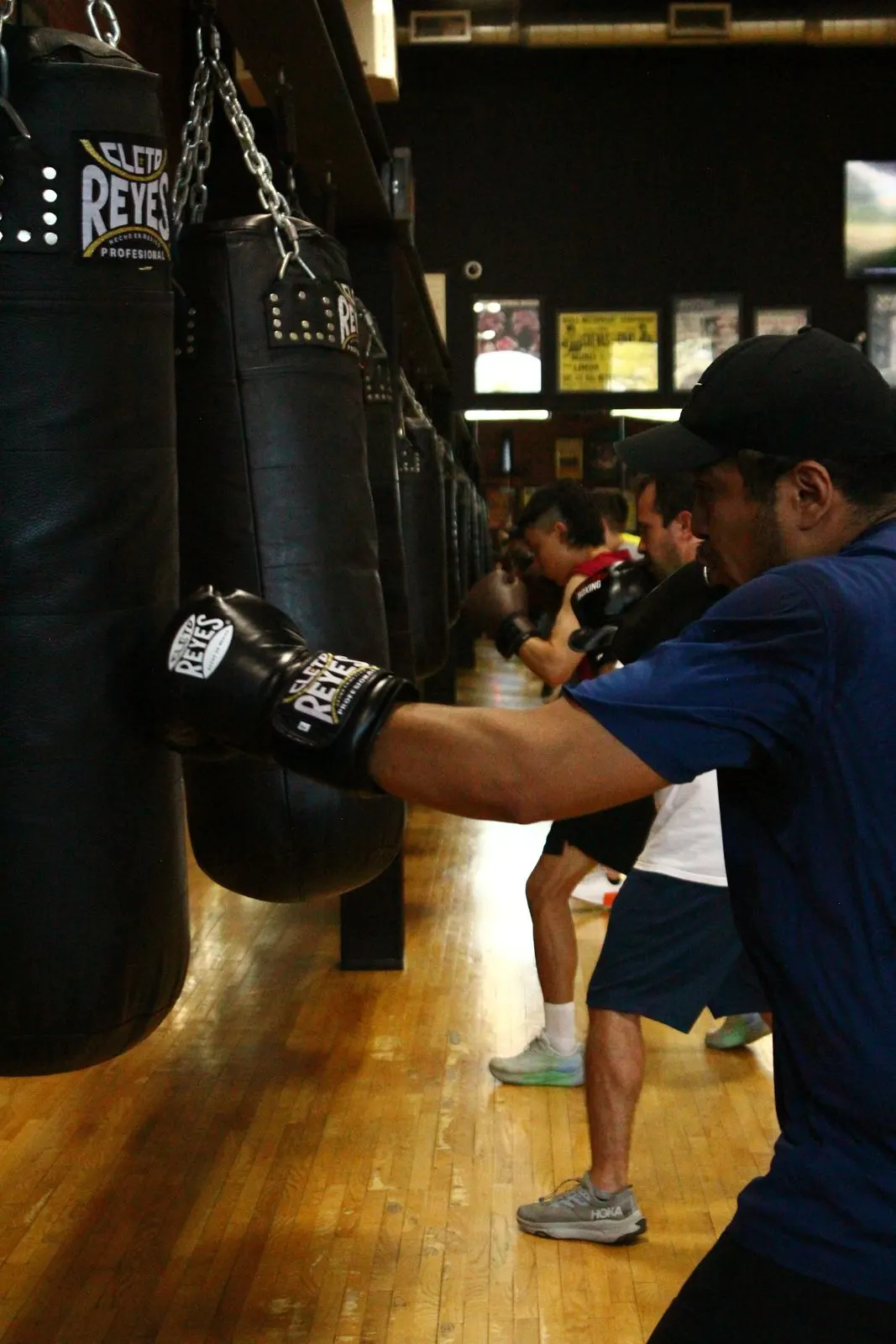
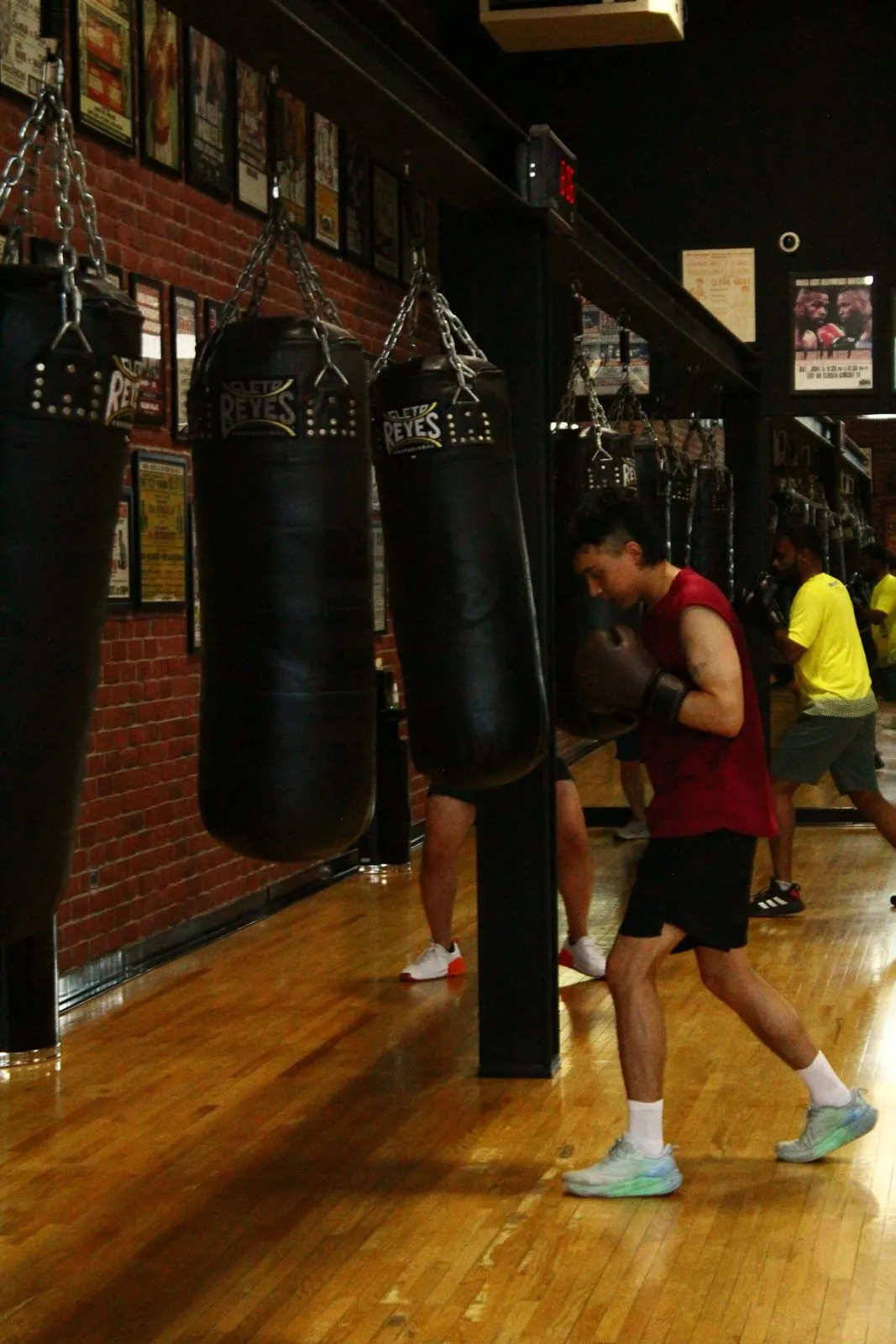
Actual photo: a Bag Blitz heavy-bag workout on the West End bag floor.
What This Means for You as the Customer: What should you ask a coach before sparring?
For a beginner at West End Athletic Club, understanding the readiness process means you can walk up to a coach and ask good questions instead of waiting to be noticed. These are the ones worth asking:
- What is the one habit you would want me to fix before I spar?
- Do you see me as a Beginner Sparring candidate yet, and what would change your mind?
- What gear do I need, and is there anything I should not buy yet?
- How do you decide who I would be paired with?
- What should I do if I want to stop during a round?
- If I want to compete one day, what does the path toward the Amateur Fight Team look like?
Expect a direct answer. Coaches here would rather tell you plainly what needs work than let you guess. You can also decline sparring at any point, even after a coach says you are ready.
For the member from Bloor West Village who trains in the women-only classes and wonders whether sparring is even on the table, the same starting point applies: ask a coach how sparring works for you. Parents of youth boxers (the youth program covers ages 4-16) should ask a coach directly how sparring applies to kids, since this article is written for adult beginners.
If you have not started yet, the path is short. Book the 3 Classes for $30 intro and tell the coach that sparring is on your mind someday. The club also offers a 2-week intro option, and for its details, along with membership and class-pack questions, visit westendac.com or call 416-621-1234.
Our take after more than a decade of coaching boxing in Etobicoke
West End Athletic Club has been coaching boxers in Etobicoke since 2015, and our view on sparring is simple: readiness is about control, and control is built on unglamorous repetition. People overweigh toughness, fitness and how hard they can hit the bag. What actually matters is whether your right hand comes home after the jab when you are tired.
The other thing beginners overweigh is speed. There is no prize for sparring early. A strong base turns your first rounds into something you want to repeat, and a rushed base turns them into something you avoid. We would rather say not yet a few extra times than watch someone lose their love for the sport in one bad round.
If a friend asked us, we would say this: go to technique classes, ask a coach one honest question, and treat the answer as a to-do list. That is the whole secret. It works.
Frequently Asked Questions
Do I have to spar to train at West End Athletic Club?
Sparring at West End Athletic Club is optional, and you can train in technique, fitness boxing and strength classes without ever sparring. If you do choose to spar, every session happens under coach supervision in the full ring at 283 Bering Ave.
How long does it take a beginner to be ready to spar?
Beginner sparring readiness at West End depends on consistency rather than a fixed number of weeks. Every 50-minute technique class gives a coach another look at your guard, footwork, control and defensive reactions. The fastest route is regular attendance and asking a coach for honest feedback on the one habit to fix.
What gear do I need for my first Beginner Sparring class?
Gear for a first Beginner Sparring class typically includes hand wraps, 16 oz sparring gloves, a fitted mouthguard, headgear and a groin protector. Confirm the exact requirements with a coach or by calling 416-621-1234 before you buy anything.
Can I go straight to Advanced Sparring if I boxed years ago?
Returning boxers with past experience are placed by a coach, who decides between Beginner Sparring and Advanced Sparring after watching them work. Tell a coach about your history at your first class at the Etobicoke club so they can make that call with you.
Sources
- Club address, 50-minute class length, coach credentials, programs and intro offer: West End Athletic Club official website
- Beginner Sparring and Advanced Sparring classes, current schedule: West End Athletic Club, Sparring
- Technique classes and the fundamentals taught before sparring: West End Athletic Club, Technique
- Kipling and Islington stations on Line 2 Bloor-Danforth, the transit corridor serving west Etobicoke: Toronto Transit Commission
West End Athletic Club
Boxing gym in Etobicoke, Toronto at 283 Bering Ave.
Start Your Path to Beginner Sparring: 3 Classes for $30 →🎧 Listen to article