
Boxing Footwork in Islington for Beginners: How Coaches Teach the First Step
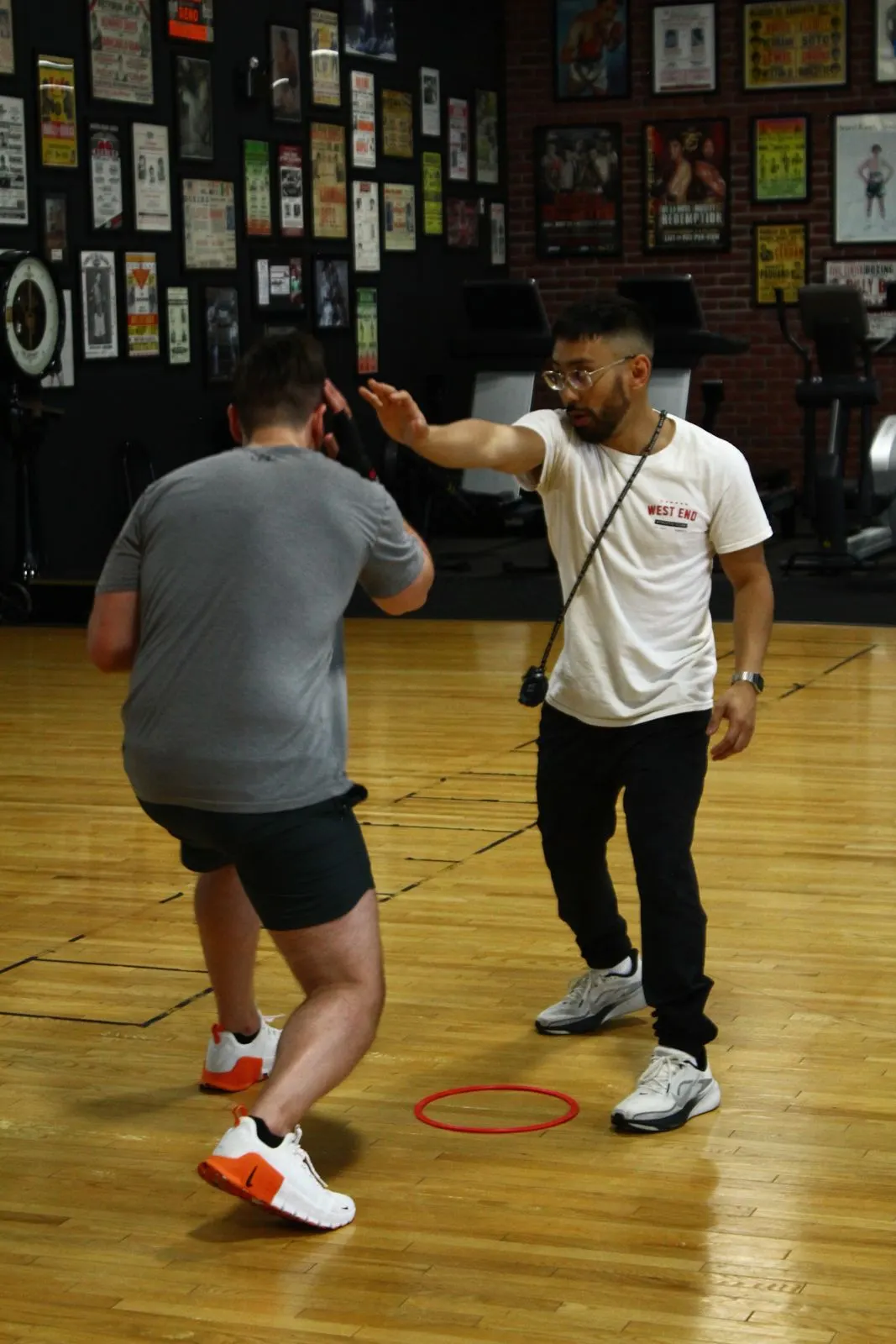
Boxing footwork in Islington for beginners starts before anyone takes a step. At West End Athletic Club (283 Bering Ave, Etobicoke), coaches first identify whether you are more comfortable in an orthodox or southpaw stance, then teach stance, balance and basic forward, backward and lateral movement, beginning in the 30-minute Intro To Boxing class. If you have never thrown a punch, book Intro To Boxing, then build on it in The Boxing Blueprint.
Last updated: November 1, 2026
Published November 1, 2026 · Updated November 1, 2026
- West End coaches teach footwork in a four-step order: orthodox or southpaw identification, stance, balance, then basic movement (forward, backward and lateral).
- Footwork fundamentals are introduced in the 30-minute Intro To Boxing class and reinforced in the 50-minute The Boxing Blueprint.
- The core stance cue is feet about shoulder-width apart, with the lead toe on one side of an imaginary line and the rear heel on the other, neither touching it.
- West End does not put a timeline on footwork progress; consistency, coordination and attention to fundamentals decide how fast it feels natural.
- New members can start with the 3 Classes for $30 intro offer: any three coach-led group classes, no auto-enrollment.
- The exact order West End coaches use to teach a beginner's first footwork.
- The simple "line between your feet" cue behind a balanced stance.
- The six footwork mistakes beginners usually make, and how coaches break them down.
- Why the club refuses to put a timeline on progress.
- Where footwork fits on the path from Intro To Boxing to regular classes and beyond.
- How do coaches teach footwork first?
- Who is this footwork coaching for?
- What should you wear and bring?
- What is the process, step by step?
- What tools and gear are used?
- Where does it get tricky?
- How long until footwork feels natural?
- What comes after the first class?
- What does this mean for you as a beginner?
- How do you start?
- Our view
- FAQ
How do coaches teach boxing footwork in Islington for beginners?
Coaches at West End Athletic Club teach beginner footwork from the ground up, in a fixed order: orthodox or southpaw identification, boxing stance, balance, then basic movement. Most people assume footwork means moving fast. It actually starts with standing correctly.
The order matters because each step depends on the one before it. You cannot balance well in a stance that is built for the wrong side, and you cannot move cleanly without balance. The goal is not simply to teach someone how to move their feet; it is to help them understand why proper footwork is essential to everything they do in boxing.
This reflects the club's C.A.P.P. Method™: Constant, Applicable, Positive, Progression. Establish the foundation first, then progressively build on it. Coaches meet members at their current level, whether that is a first punch or a return to training.
Who is this footwork coaching for?
Beginner boxing footwork coaching at West End is for people who are new to boxing and want to start taking classes. If you are an adult living along the Kipling/Islington corridor who has never thrown a punch and feels awkward the moment someone says "get in your stance," this is exactly where you start, not a step you skip.
It also suits women who want a supportive start (Coach Isa "La Guerrera" Garo leads the women's programs, Women's Box & Burn and Women's Sculpt & Strong) and people coming back to fitness after time away. Nobody needs a sports background. Regular classes are no-contact, built on bags and pads.
Parents of kids aged 4 to 16 have their own route: Little Warriors (ages 4 to 8, 45 minutes) and the Youth Boxing Academy (ages 9 to 16, 50 minutes), both non-contact, with progress tracked through the six-level Band System. More on that is on the youth boxing page.
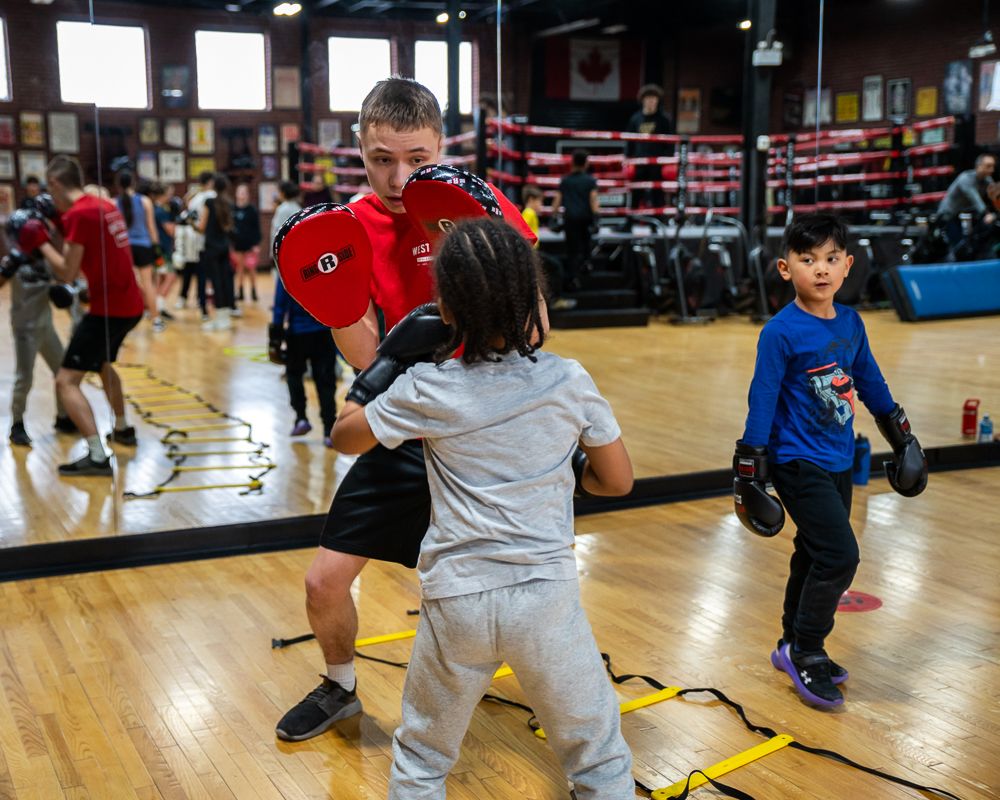
Actual photo: young boxers training with a coach at West End Athletic Club.
What should you wear and bring?
A beginner needs comfortable athletic clothing, a water bottle, boxing gloves and hand wraps. That is the full list for classes. Nothing else is required to learn footwork.
If you do not own gloves or wraps yet, West End sells both at the gym, and the club's own branded gloves are comparable to an entry-level Everlast set. Bring a towel too, because towels are not provided. Lockers are complimentary for daily use; bring your own lock or buy one at the gym.
As general advice for footwork, clothing that lets you bend your knees and shift your weight freely helps. Arrive 10 to 15 minutes before class and check in with the front desk; staff guide you through registration and check-in. If you want to loosen up, warm up inside the gym before class starts.
What is the process, step by step?
The footwork process at West End follows the club's own progression, introduced in Intro To Boxing (30 minutes) and reinforced throughout The Boxing Blueprint (50 minutes). Here is what happens, in order.
- Check in and wrap up. You arrive 10 to 15 minutes early and check in at the front desk. Intro To Boxing covers hand wraps, so you learn how to protect your hands before you throw anything.
- Orthodox or southpaw identification. Before teaching footwork, coaches identify whether you are more comfortable in an orthodox or southpaw stance. This establishes which stance is most appropriate for you as an individual.
- Boxing stance. Next comes correct foot positioning and body alignment. The cue: feet roughly shoulder-width apart, with proper separation between the lead foot and the rear foot.
- The line between your feet. Imagine a straight line running between your feet. Your lead toe stays on one side of it and your rear heel on the other, without either touching it, which gives you a balanced stance rather than feet directly in line.
- Balance. With the stance set, the focus becomes a stable foundation for punching, defending and moving. Balance is what lets you change direction without falling out of position.
- Basic movement. Only then do you step forward, backward and laterally while keeping your stance and balance. Small, controlled steps come first.
- First combinations. Intro To Boxing also covers first combinations and what a real class feels like, so the feet start working with the hands right away.
- Reinforcement in The Boxing Blueprint. The Boxing Blueprint teaches the core mechanics step by step: stance, guard, footwork and the punches. Here the same fundamentals are repeated and built on.
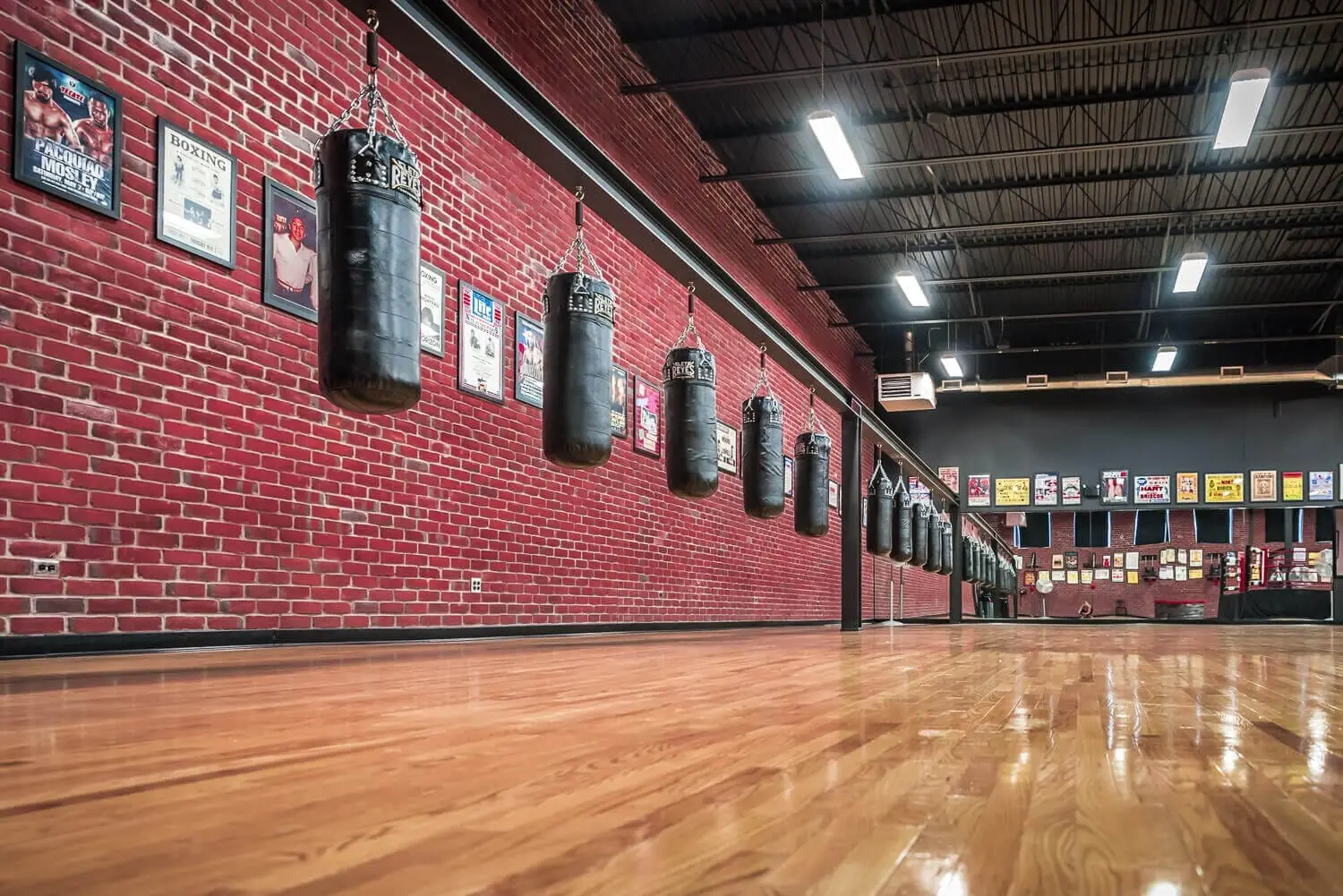
Actual photo: the heavy bags at West End Athletic Club.
What tools and gear are used?
Footwork teaching at West End uses a short list of tools, and the most important one is a coaching cue. Everything else is standard no-contact class equipment.
| Tool | Purpose in footwork training |
|---|---|
| The "line between your feet" cue | Keeps lead toe and rear heel on opposite sides of an imaginary line for a balanced stance. |
| Hand wraps | Protect the hands; taught in Intro To Boxing before any punches. Sold at the gym. |
| Boxing gloves | Needed for bag and pad work. Sold at the gym; West End's branded gloves are comparable to an entry-level Everlast set. |
| Heavy bags | A fixed target for practising stance, balance and stepping while punching, in the heavy bag room. |
| Pads | Used in no-contact class drills, where feet and hands have to work together. |
Where does it get tricky?
Footwork gets tricky for beginners because there is rarely just one mistake; most new boxers have a combination of several. Coaches see six common ones:
Facing straight ahead instead of taking a proper boxing stance.
A narrow base makes every punch and step less stable.
Crossed feet leave you briefly off balance mid-step.
Bouncing replaces controlled movement and wastes energy.
Weight drifts too far forward or sideways as the hands start working.
The base changes shape as the round goes on.
These mistakes happen because beginners concentrate on their punches rather than their feet. The hands feel like the exciting part. The feet quietly decide whether the punch works.
West End coaches correct them by breaking movements into smaller, manageable steps, reinforcing stance, positioning and weight distribution before gradually adding movement and combinations. Rather than rushing techniques, they build correct habits meant to serve members throughout their boxing journey.
How long until footwork feels natural?
Footwork feels natural on a different schedule for everyone, and West End deliberately puts no arbitrary timeline on technical progress. It depends on four things: training consistency, coordination, previous athletic experience and attention to practising fundamentals.
Coaches build confidence through repetition, correct mistakes early and introduce more complex movement as members become comfortable. The more consistently someone trains, the more familiar the movements become. Establish the fundamentals, develop good habits, and let progression happen through proper coaching and consistent practice.
What comes after the first class?
After Intro To Boxing, beginners move into regular coach-led, no-contact classes. The Boxing Blueprint teaches the core mechanics (stance, guard, footwork and the punches), and Tech-Fit Boxing adds combinations and defence at a conditioning pace.
Boxing Bootcamp is a full-body class for people new to boxing or coming back to fitness, and Bag Blitz adds intensity once someone has a class or two behind them. For the clearest footwork focus, The Boxing Blueprint is the natural next step. A fuller walk-through is in how the beginner boxing program works.
Sparring is optional and never a first-visit class. Someone who wants to spar must first take classes for 1 to 3 months, depending on skill level, while coaches continuously assess both boxing skills and character as a person. From there, members may be invited into Beginner Sparring, and anyone who later wishes to compete may be invited to the Competition Team (also called the Fight Team).
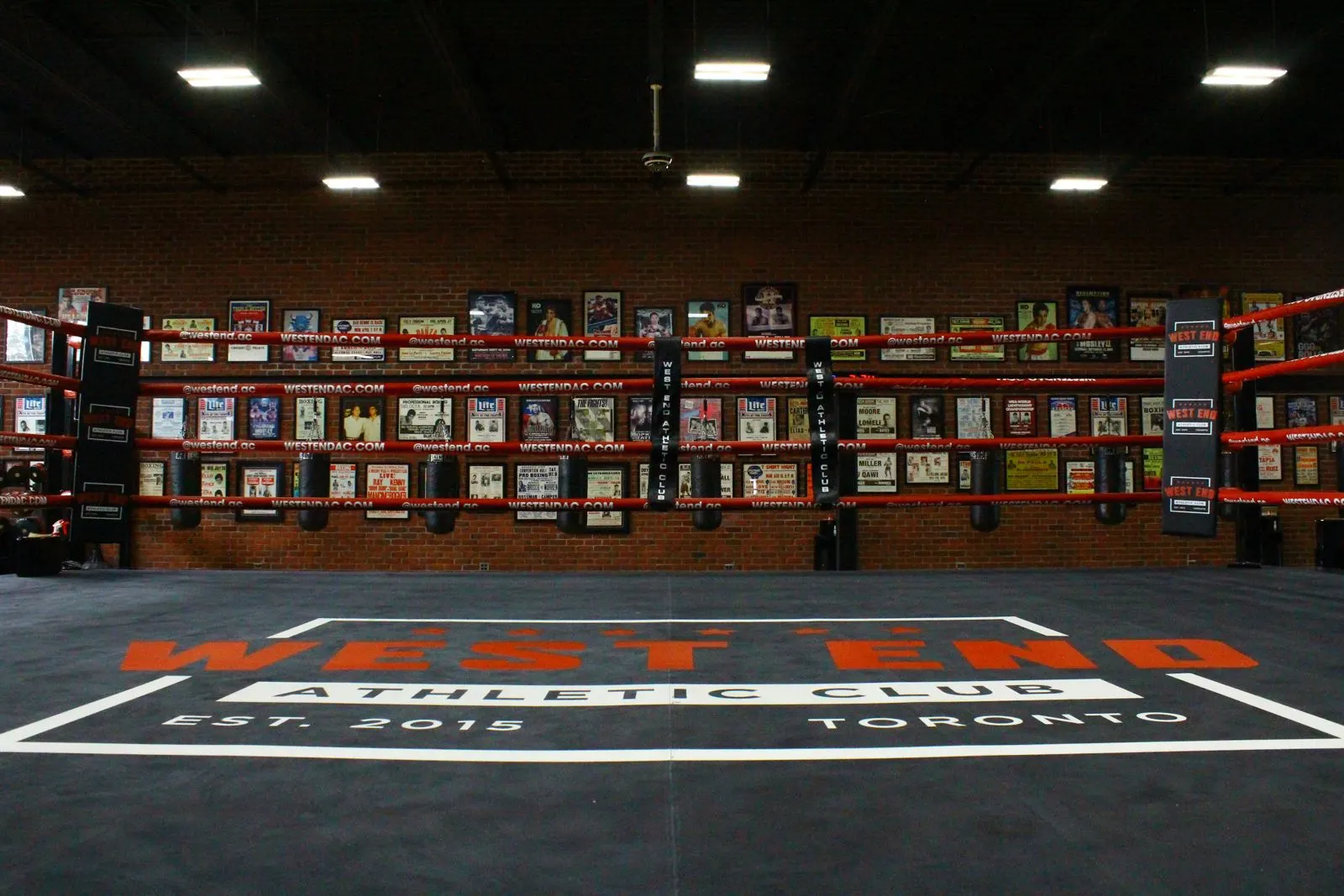
Actual photo: the ring at West End Athletic Club, used for sparring by invitation only.
What does this mean for you as a beginner?
For a beginner, West End's footwork process means your first session is about standing well, not moving fast. Expect to hear about your stance side, your foot spacing and the imaginary line between your feet before anything flashy.
For the office worker who sits most of the day and worries about looking clumsy, that is good news. The steps are small on purpose. Useful questions to ask at the front desk:
- Which upcoming Intro To Boxing class fits my week?
- Should I follow up with The Boxing Blueprint, or is the 30-minute introductory assessment a better fit for me?
- Do I need to buy gloves and wraps here, or can I bring my own?
The 30-minute introductory assessment with a coach looks at technical ability, conditioning, experience and goals, and is scheduled at different times of day depending on coach availability; you may join a regular class afterward. For someone completely new who prefers weekends, the club generally recommends The Boxing Blueprint or that assessment. If you want a feel for the room first, read what happens in your first boxing class.
How do you start?
The simplest way to start learning boxing footwork for beginners at West End is the 3 Classes for $30 intro offer: any three coach-led group classes, for new members only, with no auto-enrollment. A sensible sequence is Intro To Boxing followed by The Boxing Blueprint.
Class times change, so check the live schedule before you go. Women considering the women's programs can also look at the Women of West End 4-Week Confidence Challenge: 12 classes over 28 days for new members, with 15% off gloves and hand wraps, at $149 + HST. For memberships, see westendac.com/memberships or call 416-621-1234.
Our view
Our opinion: beginners overweight drills. Online videos promise five footwork drills to master, but a drill performed from a square, narrow stance just repeats the mistake faster.
What actually matters is the boring part: the right stance side, the line between your feet, and balance that holds when your hands start moving. Get those right and the movement drills have something to stand on. Consistency beats intensity here, which is why no timeline is promised.
FAQ
Do I need boxing experience to learn footwork?
Learning boxing footwork needs no prior experience at West End. The 30-minute Intro To Boxing class is built for anyone who has never thrown a punch, and coaches meet members at their current level.
What do I bring to my first footwork class?
Bring comfortable athletic clothing, a water bottle, boxing gloves, hand wraps and your own towel. West End sells gloves and wraps at the gym, and its branded gloves are comparable to an entry-level Everlast set.
Which class teaches footwork first?
Intro To Boxing (30 minutes) introduces footwork first: stance side, stance, balance and basic movement. The Boxing Blueprint (50 minutes) then reinforces those fundamentals step by step.
When can a beginner start sparring?
Sparring at West End requires 1 to 3 months of classes first, depending on skill level, and is by invitation only. Coaches continuously assess boxing skills and character before inviting anyone into Beginner Sparring.
Sources
- Class schedule and class names - West End Athletic Club schedule
- Membership options and intro offer - West End Athletic Club memberships
- Coaching staff and credentials - West End Athletic Club about page
West End Athletic Club
Boxing gym in Etobicoke, Toronto at 283 Bering Ave, family-owned since 2015.
Learn Your Stance: Book 3 Classes for $30- Your First Boxing Class in Etobicoke: What Actually Happens in the First 50 Minutes
- How West End Athletic Club Builds a Complete Beginner Into a Confident Boxer in Islington, The 4-Stage Path
- Women's-Only Boxing Classes Near Mimico in Etobicoke: Do You Need to Buy Gloves Before Your First Class?
- A Gym Member Asked: "Is Boxing Training Safe If I've Never Thrown a Punch?" — A Coach's Honest Answer
- Youth Boxing Classes in Etobicoke Ages 4 to 16: Is a Second Weekly Class Worth It?